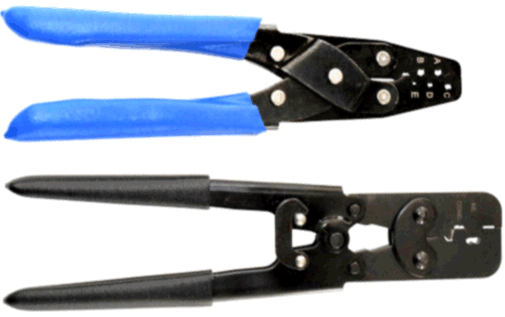
 FREE CRIMPER SET ($119 value) with purchase of RestoMod or Classic Update Wiring System.

Spark Plug Wire Sets for Classic & Muscle Cars
We manufacture (2) categories of spark plug wires: Exact Reproduction Sets and Replacement Sets.
■ EXACT REPRODUCTION SETS ■
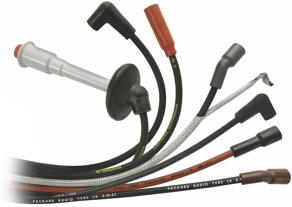
To satisfy the most discriminating enthusiast and restorer, Lectric Limited manufactures authentic reproduction spark plug wire sets for many 1929-1984 GM, Chrysler, AMC, Studebaker and Packard vehicles. These USA-made spark plug wires are identical to those that would have been installed on your vehicle when it left the factory. They look, fit, and perform exactly as original and provide the finishing touch for any original or restored vehicle.
All of our spark plug wire sets include the ignition coil wire, dielectric grease kit, and installation instructions.
Exact reproduction sets mean:
- Manufactured from the original manufacturer blueprint specifications (GM, Chrysler, AMC, Studebaker & Packard).
- Wire Conductor/Core: original wire type (core composition and insulation).
- Wire Color: original color (black, gray or brick red).
- Wire Gauge: original gauge.
- Wire Lengths: original wire lengths.
- Wire Script: original text/script.
- Wire Script Ink Color: original script ink type and ink color (white, black or yellow).
- Wire Braiding: original machine-applied metal braiding (used only on 1965-74 big block Corvettes with factory installed radio).
- Wire Manufacturer: (Delphi) Packard Electric® – the original manufacturer.
- Wire Manufacturer Country of Origin: U.S.A.
- Wire Date Code: original date code (if applicable, or as noted).
- Terminals: original configuration (45°/135°, 90°, or 180°/straight).
- Boot Color: original color (black, gray, brown or orange).
- Boot Type: original size, shape and configuration (45°/135°, 90°, or 180°/straight).
Exact Reproduction Wire Type

The type of wire used in the manufacturing process of spark plug wires is crucial. Lectric Limited utilizes various types of wire in the production of its quality GM, Chrysler and AMC spark plug wire sets, each crafted with different materials and construction techniques.
Exact Reproduction/Original Terminals

We only use original or exact reproduction terminals, in the original metal composition when manufacturing our spark plug wire sets. All of our terminals are machine-applied (not hand-applied) using dedicated applicator dies in a 5-ton press. Machine-applied terminals ensure consistent, precise, and air gap-free terminations.
Exact Reproduction Boots

For an exact fit and authentic appearance, our spark plug wire boots are meticulously reproduced in material chosen for durability, ability to resist high temperatures, and electrical insulating properties, ensuring that the boots can protect the ignition system and maintain optimal performance. Our boots are also manufactured in the correct orientation (90°, 135°, 180°/straight) in original colors.
Exact Reproduction Metal Braiding (select models)

In the ’60s & ’70s, certain GM big-block high-performance engines were equipped from the factory with distinctive spark plug wires featuring metal (over) braiding. This metal braiding, made of tin-plated copper, offered enhanced protection against wear, heat, and electrical interference. If you’re restoring one of these classic GM vehicles from this era, Lectric Limited manufactures wires with the correct metal braiding for performance and authenticity.
Exact Reproduction Date Codes

For the purist or restorer, we manufacture date coded spark plug wires. But what are “date coded” wires?
In January 1961, spark plug wire manufacturers began to print a manufacturing date on their wires for their own internal identification (quality control) purposes. Note: 1961 G.M., Chrysler and AMC vehicles built prior to January 1961 did not use date coded wires. Research has shown that most vehicles had wires installed that had a date “code” anywhere from 1 to 4 quarters prior to the build date of the vehicle. This equates to an actual time period of 1 to 12 months. Lectric Limited’s spark plug wire sets are either date coded the first quarter (1-Q) or third quarter (3-Q) of each year, starting with 1961. Second and fourth quarter date codes are not available at this time, nor should it be necessary due to the wide spread of 1 to 12 months previously mentioned.
A production run of a particular model vehicle actually began in September or October of the previous year. For example: The first 1962 model vehicles actually left the assembly line in September or October of 1961. Keeping this in mind, you should determine when your car was manufactured and accordingly order the date code (quarter and year) for your spark plug wires. For Corvette, the serial numbers shown below are the last 5 numbers of the Corvette’s serial/VIN number. This number corresponds to the Corvette’s build sequence number. For example: 05966 was the 5,966th Corvette to come off the production line that year. You can also determine the recommended spark plug wire date code by the vehicle’s build date. This build date applies to all General Motors, Chrysler and AMC vehicles.
– THE DATE CODE WE RECOMMENDED –
| Model Year | Corvette Serial / VIN Last 5 Numbers | GM, Chrysler or AMC Vehicle Build Date | Recommended Spark Plug Wire Date Code |
|---|---|---|---|
| 1961 | 00001 thru 05966 05967 thru 10939 | Sept. 1960 – Feb. 1961 Mar. 1961 – Aug. 1961 | NOT DATED 1-Q-61 |
| 1962 | 00001 thru 07585 07586 thru 14531 | Sept. 1961 – Feb. 1962 Mar. 1962 – Aug. 1962 | 3-Q-61 1-Q-62 |
| 1963 | 00001 thru 09814 09815 thru 21513 | Sept. 1962 – Feb. 1963 Mar. 1963 – Aug. 1963 | 3-Q-62 1-Q-63 |
| 1964 | 00001 thru 12322 12323 thru 22229 | Sept. 1963 – Feb. 1964 Mar. 1964 – Aug. 1964 | 3-Q-63 1-Q-64 |
| 1965 | 00001 thru 11059 11060 thru 23564 | Sept. 1964 – Feb. 1965 Mar. 1965 – Aug. 1965 | 3-Q-64 1-Q-65 |
| 1966 | 00001 thru 15283 15284 thru 27720 | Sept. 1965 – Feb. 1966 Mar. 1966 – Aug. 1966 | 3-Q-65 1-Q-66 |
| 1967 | 00001 thru 12264 12265 thru 22940 | Sept. 1966 – Feb. 1967 Mar. 1967 – Aug. 1967 | 3-Q-66 1-Q-67 |
| 1968 | 00001 thru 12647 12648 thru 28566 | Sept. 1967 – Feb. 1968 Mar. 1968 – Aug. 1968 | 3-Q-67 1-Q-68 |
| 1969 | 00001 thru 17571 17572 thru 38762 | Sept. 1968 – Feb. 1969 Mar. 1969 – Aug. 1969 | 3-Q-68 1-Q-69 |
| 1970 | 00001 thru 05183 05184 thru 17316 | Sept. 1969 – Feb. 1970 Mar. 1970 – Aug. 1970 | 3-Q-69 1-Q-70 |
| 1971 | 00001 thru 10886 10887 thru 21801 | Sept. 1970 – Feb. 1971 Mar. 1971 – Aug. 1971 | 3-Q-70 1-Q-71 |
| 1972 | 00001 thru 15020 15021 thru 27004 | Sept. 1971 – Feb. 1972 Mar. 1972 – Aug. 1972 | 3-Q-71 1-Q-72 |
| 1973 | 00001 thru 16301 16302 thru 34464 | Sept. 1972 – Feb. 1973 Mar. 1973 – Aug. 1973 | 3-Q-72 1-Q-73 |
| 1974 | 00001 thru 19258 19259 thru 37502 | Sept. 1973 – Feb. 1974 Mar. 1974 – Aug. 1974 | 3-Q-73 1-Q-74 |
■ REPLACEMENT SETS ■

For those seeking a budget-friendly option or simply high-quality spark plug wires for their everyday vehicle, Lectric Limited also manufactures “replacement” spark plug wire sets. These sets are a cost-effective alternative to our factory-original “reproduction” wires. Designed to resemble the original look and fit better than generic auto parts store wires, our replacement sets are available for many 1958-74 GM and Chrysler cars and trucks.
All of our spark plug wire sets include the ignition coil wire, dielectric grease kit, and installation instructions. Manufactured in the USA.
The differences between a “reproduction” and a “replacement” set are noted with an asterisk (*) below.
Replacement sets mean:
- Wire Conductor/Core: original wire type (core composition and insulation).
- Wire Color: original color (black or gray).
- Wire Gauge: original gauge.
- Wire Lengths: original or longer wire lengths (0 – 4″ longer). *
- Wire Script for GM vehicles: non-original text/script *. Not date coded. *
- Wire Script for Chrysler vehicles: original text/script. Not date coded. *
- Wire Script Ink Color: original script ink type and ink color (white, black or yellow).
- Wire Braiding: original machine-applied metal braiding (used only on 1965-74 big block Corvettes with factory installed radio).
- Wire Manufacturer: (Delphi) Packard Electric® – the original manufacturer.
- Wire Manufacturer Country of Origin: U.S.A.
- Wire Date Code: not date coded. *
- Terminals: original configuration (45°/135°, 90°, or 180°/straight).
- Boot Color: original color (black, gray, brown or orange).
- Boot Type: similar appearance and currently available configuration to original (45°/135°, 90°, or 180°/straight). *
Use the “Fit My Vehicle” selection above to shop spark plug wires for your specific vehicle.
What does the script represent on spark plug wires?

American automobile manufacturers began to script spark plug wires (i.e., print or label them with specific branding, part numbers, or designations) in the late 1950s to differentiate the wires and provide more detailed information for identification, material type, resistance specifications, and performance purposes. To follow are what the script means and what the acronyms mean.
7MM / 8MM – The outer diameter (in millimeters) of the outer insulation of a spark plug wire. An 8mm wire has thicker insulation than a 7mm wire.
DATE CODE – Example, 3-Q-62. See explanation above.
‘DELCORE‘ – Delcore Electrical Products, a company known for producing automotive electrical components, including spark plug wires, ignition parts, and related accessories. ‘Delcore’ is now a registered trademark of Lectric Limited, Inc.
‘ELECTRONIC SUPPRESSION‘ – Same as ‘TVRS’.
‘H‘ – “Heavy Duty” or “High Performance”. This designation was used to indicate that the spark plug wires were built with enhanced durability or performance features, making them suitable for more demanding applications. The “H” could indicate: ‘Heavy Duty Construction’ designed to withstand higher temperatures, more intense electrical loads, or more extreme operating conditions. High-Performance optimized for better conductivity, lower resistance, or enhanced suppression of electromagnetic interference (EMI), providing more efficient engine performance and reducing radio and TV interference.
‘Lightning Bolt‘ symbol – On TVRS spark plug wires, this symbol indicates that the wires are designed for transient voltage suppression and are specifically engineered to reduce electromagnetic interference (EMI) or radio frequency interference (RFI). The wire is constructed with a suppressive core that helps prevent voltage transients that occur when spark plugs fire, thereby reducing electrical noise that could be picked up by a radio or television set.
‘PACKARD‘ – or ‘Packard Electric’ was a major American manufacturer of electrical components, particularly known for producing automotive spark plug wires, wiring harnesses and wiring systems. During the 1960s-70s, Packard Electric was a division of General Motors (GM). In the 1980s, Packard Electric was restructured, and its operations were eventually consolidated under Delphi Packard Electric Systems. Some spark plug wire sets have the Packard 3-arrow insignia printed on them.

‘PACKARD 440‘ – Refers to a specific type of wire produced by Packard Electric. This wire was designed as a high-performance spark plug wire, intended for use in automotive ignition systems, particularly in vehicles requiring robust electrical conductivity and minimal resistance. 440 wire is a resistor wire, which means it has a built-in resistance element within the wire’s core, making it different from solid core wires. This resistance helps to limit the amount of EMI (electromagnetic interference) that can be emitted by the ignition system, ensuring that the vehicle’s electronics and radio would not experience static or signal interference.
‘LR‘ – Spark plug wires with this designation were designed to have “Low Resistance” in the conductor material. This feature was important because low-resistance spark plug wires allowed for more efficient electrical current flow from the ignition system to the spark plugs, ensuring better performance and more reliable engine ignition. The low-resistance design also reduced the amount of electrical resistance that could interfere with the ignition system, and in some cases, it helped reduce radio interference (which was particularly important in the 1960s-70s era when car radios were more prone to static and interference from ignition systems).
‘RADIO GM TVRS‘ – Same as ‘TVRS’.
‘RADIO TVRS‘ – Same as ‘TVRS’.
‘SUPPRESSION‘ – Same as ‘TVRS. Suppression wires have a conductor with resistance.
‘TVRS‘ – This acronym stands for ‘TV and Radio Suppression’ in the context of spark plug wires from the 1960s and 1970s. This refers to a type of spark plug wire designed to reduce electromagnetic interference (EMI) that could disrupt the reception of television and radio signals. In that era, vehicles equipped with conventional ignition systems would sometimes generate electrical noise, causing static or interference in nearby radio or TV broadcasts. “TVRS” spark plug wires were designed to suppress this interference, ensuring that the ignition system didn’t create unwanted noise or signal disruption, thus improving the quality of radio and television reception while the vehicle was operating. These wires typically featured materials or designs that reduced the electrical “noise” generated by the spark plug firing.
‘TV-R SUPPRESSION‘ – Same as ‘TVRS’.